
Modern commercial buildings such as offices, malls, hospitals, hotels, factories, and educational institutions require efficient climate control to ensure comfort, productivity, and safety. This is where commercial HVAC systems play an important role. These systems are designed to handle large spaces, varied occupancy levels, and continuous operation. Understanding how these systems work helps building owners and facility managers make informed decisions.
In this blog we explains how commercial HVAC systems work, their types, components, and how to choose the right system for your building.
Understanding Commercial HVAC Systems
Commercial HVAC systems are designed to control heating, ventilation, and air conditioning in large buildings. Unlike residential systems, commercial building HVAC systems are more complex, powerful, and customizable. They are built to maintain consistent indoor temperature, manage humidity, and improve air quality across multiple zones.
In commercial spaces, HVAC systems must handle Large floor areas, High foot traffic, Heat generated by equipment and lighting, Different temperature needs in different zones.
Because of these factors, a commercial HVAC system is engineered with advanced controls, ducting, and air distribution methods.
What is an HVAC System?
HVAC stands for Heating, Ventilation, and Air Conditioning. An HVAC system is responsible for:
- Heating indoor spaces during cold conditions
- Cooling indoor spaces during hot conditions
- Circulating and filtering air for proper ventilation
In simple words, HVAC systems regulate indoor climate and ensure clean, comfortable air. In HVAC commercial applications, systems are larger and more robust to meet demanding operational needs.
How Does an HVAC System Work?
An HVAC system works by combining multiple components into one integrated process:
- Heating Unit – Generates heat using electricity, gas, or hot water.
- Cooling Unit – Removes heat using refrigeration cycles.
- Ventilation System – Brings in fresh air and removes stale air.
- Ductwork – Distributes conditioned air throughout the building.
- Controls and Thermostats – Monitor and regulate temperature and airflow.
These components work together to maintain a comfortable indoor environment.
How Do Commercial HVAC Systems Work?
The working principle of commercial HVAC systems is similar to residential systems, but on a much larger and more controlled scale. A commercial HVAC system draws air from inside the building, conditions it (heating or cooling), filters it, and then redistributes it through ducts or air handling units. At the same time, fresh outdoor air is mixed in to maintain indoor air quality.
Many commercial building HVAC systems are divided into zones. Each zone can be controlled independently, allowing different temperatures in different areas of the building. This zoning system improves comfort and energy efficiency. Automation and building management systems (BMS) are often integrated to monitor performance, control energy usage, and detect faults early.
Types of Commercial HVAC Systems
There are several types of commercial HVAC systems available, each suitable for different building sizes and requirements.
1. Centralized HVAC System
A centralized HVAC system uses a central plant to produce cooling or heating, which is then distributed throughout the building. Key Features:
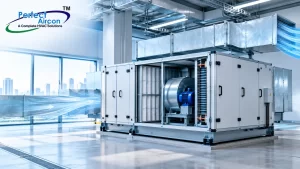
- Uses chillers, boilers, and air handling units
- Suitable for large buildings like hospitals, malls, and airports
- Provides consistent temperature control
- Requires dedicated plant room and skilled maintenance
Centralized systems are common in large commercial spaces where long-term efficiency and centralized control are required.
2. Packaged HVAC System
A packaged HVAC system combines heating and cooling components into a single unit, usually installed on the rooftop or outside the building. Key Features:
- Compact and space-saving design
- Easier installation compared to centralized systems
- Ideal for medium-sized commercial buildings
- Lower initial cost
These systems are commonly used in offices, retail stores, and small commercial complexes.
3. Individual (Decentralized) HVAC Systems
Individual HVAC systems operate independently for different areas or rooms within a building. Each unit controls a specific zone. Key Features:
- Independent temperature control
- Flexible installation
- Easy maintenance
- Suitable for small to medium commercial spaces
Examples of Individual HVAC Systems:
- Split air conditioning systems
- VRF / VRV systems
- Window air conditioners
- Cassette and ducted split units
These systems are ideal where zoning and energy control are important.
Choosing the Right Commercial HVAC System
Selecting the right commercial HVAC system depends on several important factors:
1. Building Size and Layout- Large buildings may need centralized systems, while smaller buildings can use packaged or decentralized systems.
2. Usage Type- Hospitals, offices, factories, and shopping malls all have different HVAC needs.
3. Energy Efficiency- Energy-efficient HVAC commercial systems help reduce operating costs and environmental impact.
4. Budget- Initial investment, operating cost, and maintenance expenses should be considered together.
5. Future Expansion- Choose a system that can be upgraded or expanded if the building grows.
Consulting an experienced HVAC professional like Perfect Aircon ensures the system is properly designed and installed for long-term performance.
Importance of Proper Installation and Maintenance
Even the best commercial HVAC systems will not perform efficiently without proper installation and regular maintenance. Correct duct design, airflow balancing, and system commissioning are essential for optimal performance. Routine maintenance helps:
- Improve system efficiency
- Extend equipment life
- Reduce breakdowns
- Maintain indoor air quality
Conclusion
Understanding how commercial HVAC systems work helps building owners and facility managers choose the right solution for their needs. From centralized and packaged systems to individual HVAC units, each system offers unique advantages depending on building size, usage, and budget.
Well-designed commercial building HVAC systems improve comfort, energy efficiency, and productivity. By selecting the right commercial HVAC system and working with experienced professionals like Perfect Aircon, businesses can ensure reliable climate control and long-term operational success.