
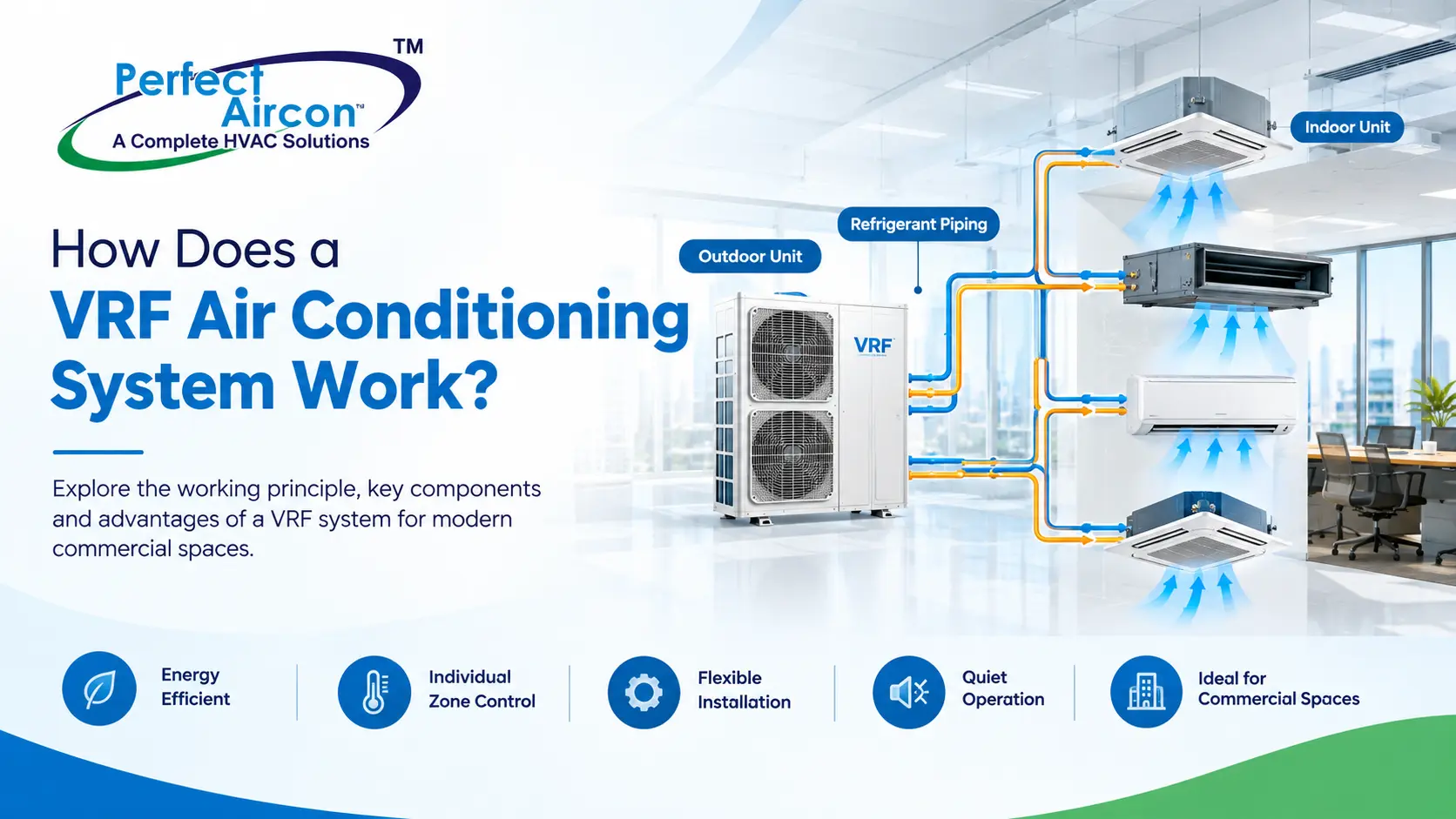
Modern commercial buildings need an air-conditioning system that can provide reliable cooling, maintain comfortable indoor temperatures, and operate efficiently across different spaces. A VRF system is one such solution that has become popular in offices, hotels, hospitals, retail spaces, restaurants, and other large buildings.
But how does a VRF air conditioning system work? Unlike conventional air-conditioning systems that generally operate with fixed refrigerant flow, VRF technology adjusts the amount of refrigerant supplied to individual indoor units according to the cooling or heating demand of each zone.
This makes VRF suitable for buildings where different rooms may have different temperature requirements. Perfect Aircon provides air-conditioning services designed around the specific requirements of commercial and industrial spaces.
What Is VRF Air Conditioning?
VRF stands for Variable Refrigerant Flow. It is a multi-zone air-conditioning technology in which a single outdoor condensing unit can connect with multiple indoor units through refrigerant piping.
The main idea behind what is VRF air conditioning is simple: the system continuously varies the refrigerant flow according to the actual demand of each indoor space.
For example, a conference room may require more cooling when it is occupied, while a storage room may need very little cooling. A VRF system can distribute refrigerant accordingly instead of delivering the same cooling capacity to every area.
Depending on the design, VRF systems can provide cooling only or both heating and cooling.
Also Read: A Comprehensive Guide to Commercial HVAC Preventive Maintenance
Main Components of a VRF System
Understanding the major components makes the VRF system working principle easier to understand.
1. Outdoor Unit
The outdoor unit contains key components such as the compressor, condenser coil, fans, and control systems. The compressor adjusts its operation according to the cooling demand of the connected indoor units.
2. Indoor Units
Indoor units are installed inside individual rooms or zones. Different types of indoor units can be selected according to the building design, including cassette, ducted, wall-mounted, and concealed units.
3. Refrigerant Piping
Copper refrigerant pipes connect the outdoor unit with multiple indoor units. These pipes carry refrigerant between the indoor and outdoor sections of the system.
4. Expansion Devices
Expansion valves regulate the refrigerant entering individual indoor units. Electronic expansion valves can precisely control refrigerant flow based on the requirement of each zone.
5. Control System
Sensors, controllers, thermostats, and communication systems continuously monitor operating conditions. This allows the system to adjust refrigerant flow and compressor performance automatically.
VRF System Working Principle
The VRF system working principle is based on matching refrigerant flow with the actual cooling or heating requirement of different zones.
When an indoor unit detects that a room needs more cooling, it communicates the requirement to the system controller. The outdoor unit then adjusts compressor operation and refrigerant flow to provide the required capacity.
The basic working process is as follows:
Step 1: Cooling Demand Is Detected
Each indoor unit monitors the temperature of its designated area. When the room temperature rises above the set point, the indoor unit sends a demand signal to the control system.
Step 2: Compressor Adjusts Capacity
The outdoor unit responds to the combined demand of the connected indoor units. In many VRF systems, an inverter-driven compressor changes its speed according to the required capacity.
Instead of operating continuously at full capacity, the compressor can increase or decrease its output.
Step 3: Refrigerant Flow Is Adjusted
The system supplies the required amount of refrigerant through the refrigerant piping network. Electronic expansion valves at the indoor units help regulate refrigerant flow to individual zones.
Areas requiring more cooling receive more refrigerant, while areas with lower demand receive less.
Step 4: Heat Is Absorbed Indoors
At the indoor unit, the refrigerant absorbs heat from the room air. The indoor fan circulates air across the coil, and the cooled air is then returned to the room.
Step 5: Heat Is Released Outdoors
The refrigerant carrying absorbed heat returns to the outdoor unit. The condenser releases this heat into the outdoor environment, completing the refrigeration cycle.
This process continues automatically to maintain the desired indoor temperature.
How Does VRF Provide Individual Zone Control?
One of the important advantages of VRF technology is its ability to control different zones independently.
Consider a hotel with several rooms. Some rooms may be occupied while others are vacant. A conventional system may provide cooling to a larger area regardless of individual requirements. A VRF system, however, can adjust refrigerant flow to each indoor unit.
This zone-based operation allows users to select different temperature settings for different spaces while the central system manages overall capacity.
Cooling and Heat Recovery in VRF Systems
There are different configurations of VRF technology.
A heat pump VRF system generally operates in either cooling or heating mode for the connected system.
A heat recovery VRF system can provide simultaneous cooling and heating in different zones, depending on the system configuration.
For example, a building may have a sunny room requiring cooling while another area requires heating. A heat recovery system can transfer heat between zones rather than simply rejecting all available heat outdoors.
This can be particularly useful in hotels, office buildings, hospitals, and other multi-zone facilities.
Benefits of Installing a VRF System
Energy-Efficient Operation
Because refrigerant flow and compressor capacity can be adjusted according to demand, a VRF system can avoid unnecessary full-capacity operation.
Individual Temperature Control
Different rooms can maintain different temperature settings according to their occupancy and usage requirements.
Flexible Installation
Multiple indoor units can be connected to an outdoor system, making VRF suitable for buildings with several rooms and zones.
Space-Saving Design
Compared with installing numerous independent air-conditioning systems, a properly designed VRF installation can provide centralized outdoor equipment with multiple indoor units.
Quiet Operation
Modern VRF systems are designed for relatively quiet indoor and outdoor operation, making them suitable for offices, hotels, healthcare facilities, and other occupied spaces.
Better Building Management
VRF systems can integrate with centralized controls and building management systems, allowing operators to monitor and manage different zones.
Where Is a VRF System Used?
A VRF system is commonly considered for applications where multiple zones require independent temperature control.
Typical applications include:
- Corporate offices
- Hotels and resorts
- Hospitals and healthcare facilities
- Shopping malls and retail stores
- Restaurants
- Educational institutions
- Banks and commercial buildings
- Showrooms
- Residential complexes
- Business centers
The final system configuration depends on factors such as building size, heat load, occupancy, room layout, operating requirements, and available installation space.
VRF vs Conventional Air Conditioning
The major difference is the way cooling capacity is delivered.
A conventional air-conditioning arrangement may use separate units or centralized equipment designed around a particular capacity. VRF technology continuously varies refrigerant flow and compressor output according to changing demand.
This makes VRF particularly useful where cooling requirements change throughout the day or where different rooms require independent temperature control.
However, proper design is essential. Refrigerant piping length, height differences, indoor-unit capacity, outdoor-unit selection, electrical requirements, ventilation, and building heat load should all be evaluated before installation.
Why Professional VRF Design Matters
A VRF system should not be selected only on the basis of building area. Correct cooling-load calculations and equipment selection are important for achieving reliable performance.
An experienced HVAC professional can assess:
- Building cooling load
- Number and type of indoor units
- Outdoor unit capacity
- Refrigerant piping requirements
- Room usage and occupancy
- Electrical requirements
- Control requirements
- Installation conditions
- Future maintenance access
Poor system sizing or improper piping can affect performance and operating efficiency. Professional planning therefore plays an important role in the long-term operation of the system.
Choose Perfect Aircon for VRF Air Conditioning Solutions
Selecting the right air-conditioning technology is only one part of a successful HVAC project. Proper planning, equipment selection, installation, testing, and commissioning are equally important.
Perfect Aircon offers commercial air-conditioning solutions with a focus on practical system design and application-specific requirements. Whether the project involves an office, hotel, showroom, hospital, restaurant, or other commercial facility, the VRF configuration can be planned according to the building’s cooling requirements and zoning needs.
If you are considering a VRF installation, professional consultation can help determine the appropriate system capacity, indoor-unit configuration, piping arrangement, and control strategy for your project.
Conclusion
So, how does a VRF air conditioning system work? It works by continuously adjusting refrigerant flow and compressor capacity according to the cooling or heating demand of individual zones. Indoor units communicate their requirements to the control system, while the outdoor unit regulates refrigerant circulation to match the changing load.
With individual zone control, flexible installation, and demand-based operation, a VRF system can be a practical solution for many modern commercial buildings. The key to achieving reliable performance is proper system design, accurate load calculation, professional installation, and regular maintenance.