In modern commercial buildings, maintaining comfortable temperature, clean air, and proper ventilation is just as important as providing cooling. This is where an AHU (Air Handling Unit) becomes an important part of an HVAC system. AHUs are widely used in offices, hospitals, hotels, shopping malls, factories, airports, and other large buildings where air quality and temperature need to be controlled continuously.
If you are searching for what is an AHU, its working principle, types, or applications, this guide explains the complete concept in simple and practical terms.
What Is an AHU?
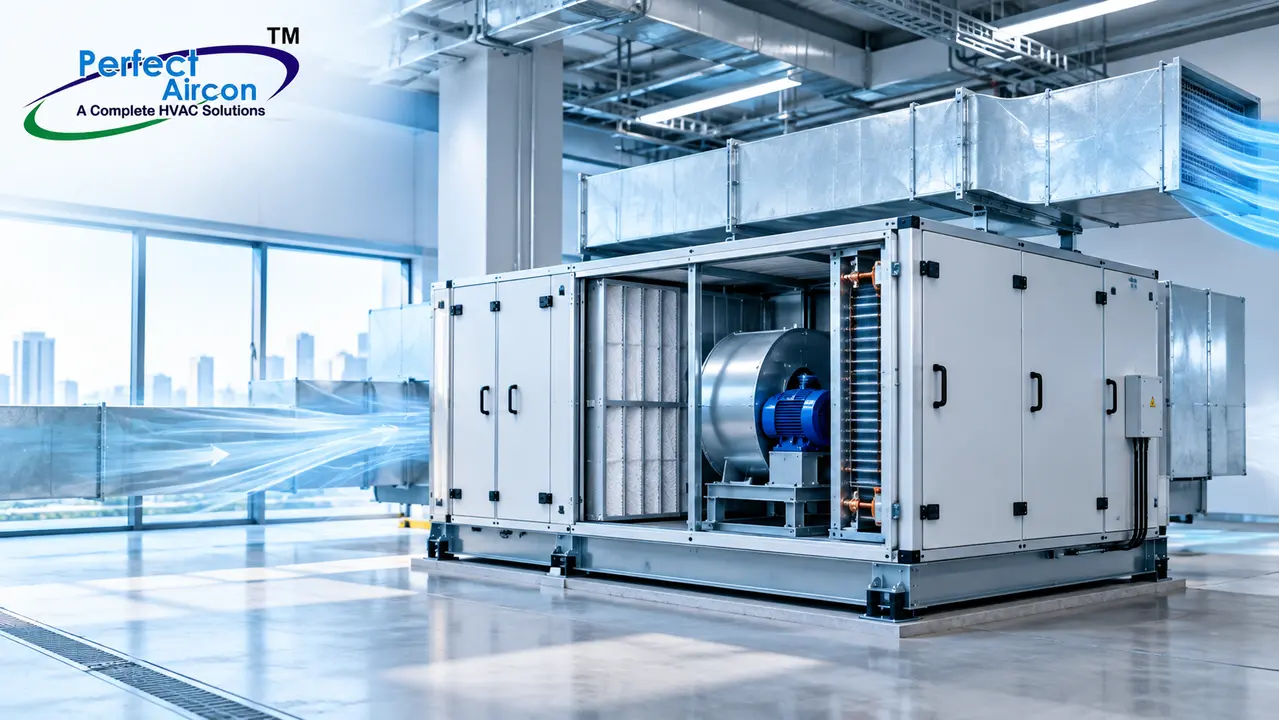
An AHU, or Air Handling Unit, is an HVAC equipment assembly designed to condition and circulate air throughout a building or specific area. It can filter, cool, heat, humidify, dehumidify, and distribute air according to the requirements of the space.
The AHU full form is Air Handling Unit. You may also see the term AHU unit full form used in HVAC discussions, which has the same meaning: Air Handling Unit.
An AHU is generally connected to ductwork that carries conditioned air to different rooms and returns used air back to the unit. Depending on the application, the unit can handle fresh outdoor air, return air, or a mixture of both.
Also Read: How Does a VRF Air Conditioning System Work?
Main Components of an AHU
An AHU consists of several components that work together to condition and circulate air.
1. Air Filters
Filters remove dust, dirt, particles, and other contaminants from the air before it enters the conditioned space. Different filtration levels can be selected depending on the building’s requirements.
2. Cooling Coil
The cooling coil reduces the temperature of air passing through the AHU. Chilled water or refrigerant may be used as the cooling medium, depending on the HVAC system design.
3. Heating Coil
In applications where heating is required, a heating coil can increase the temperature of the air before distribution.
4. Blower or Fan
The fan creates the airflow required to move conditioned air through the ductwork. Fan selection depends on airflow volume and system pressure requirements.
5. Dampers
Dampers regulate airflow and help control the amount of fresh air, return air, and exhaust air entering or leaving the unit.
6. Humidity Control Components
Some AHUs include humidifiers or dehumidification arrangements to maintain the desired moisture level inside the building.
7. Control System
Sensors and controllers monitor temperature, humidity, pressure, airflow, and other operating parameters. The control system helps maintain the required indoor conditions.
AHU Working Principle
The AHU working principle is based on taking air, filtering it, conditioning it, and distributing it to the required area.
The exact sequence can vary depending on the AHU design, but a typical process works as follows:
Step 1: Air Enters the AHU
The unit receives air through an intake section. Depending on the system, this may include fresh outdoor air, return air from the building, or a combination of both.
Step 2: Air Is Filtered
The incoming air passes through filters that remove dust and airborne particles. Filtration helps protect HVAC components while improving indoor air cleanliness.
Step 3: Air Is Conditioned
After filtration, the air passes through heating or cooling coils. During cooling operation, heat is removed from the air. During heating operation, heat is added.
The air may also undergo humidity control depending on the requirements of the application.
Step 4: Fan Moves the Air
The conditioned air passes through the blower or supply fan. The fan provides sufficient pressure to move the air through ducts and deliver it to different rooms.
Step 5: Conditioned Air Is Distributed
The supply duct network carries conditioned air to different zones through diffusers, grilles, or other air distribution outlets.
Step 6: Return Air Comes Back
After circulating through the occupied space, a portion of the air can return to the AHU through return ducts. Depending on the system design, some air may be exhausted while the remaining air is mixed with fresh outdoor air and conditioned again.
This continuous process helps maintain stable indoor environmental conditions.
Simple AHU Diagram
A simple AHU diagram can be understood as a basic airflow path:
Fresh Air + Return Air → Mixing Section → Filters → Cooling/Heating Coil → Fan → Supply Duct → Conditioned Space → Return Duct → AHU
This basic sequence makes it easier to understand how an AHU works without getting into complicated HVAC engineering details.
For technical planning, an air handling unit diagram may include additional components such as pre-filters, fine filters, cooling coils, heating coils, humidifiers, dampers, sensors, fans, vibration isolators, and control panels.
Types of AHU
AHUs can be designed in different configurations depending on the building and application.
1. Fresh Air Handling Unit
A fresh air AHU primarily handles outdoor air and supplies it into the building. These units are useful where ventilation requirements are high.
2. Return Air AHU
A return air AHU works mainly with air returned from the conditioned space. It can recirculate and condition the air before sending it back into the building.
3. Packaged AHU
Packaged units contain major components within a single factory-assembled housing. They can simplify installation and are suitable for various commercial applications.
4. Modular AHU
Modular AHUs are assembled from different sections according to project requirements. This allows flexibility in selecting filtration, cooling, heating, fan, and other sections.
5. Double-Skin AHU
Double-skin construction provides an insulated enclosure around the internal components. It is commonly considered for applications where better thermal and acoustic performance is required.
6. Custom-Built AHU
Custom AHUs are designed according to specific project requirements. They can be configured for special airflow volumes, filtration levels, temperature conditions, pressure requirements, and space limitations.
Applications of Air Handling Units
AHUs are commonly used where centralized air treatment and distribution are required.
Commercial Buildings
Offices, business centers, shopping complexes, and large commercial spaces use AHUs for temperature control and ventilation.
Hospitals
Healthcare facilities have strict requirements for filtration, ventilation, temperature, humidity, and pressure control. Specialized AHU configurations can be used for different hospital areas.
Hotels
Hotels require comfortable and consistent indoor conditions across guest rooms, restaurants, conference rooms, lobbies, and other spaces.
Industrial Facilities
Factories and production areas may use AHUs to control temperature, humidity, dust levels, and ventilation according to process requirements.
Pharmaceutical and Cleanroom Facilities
Air handling systems play an important role in controlled environments where air filtration, temperature, humidity, and pressure need to be maintained within defined limits.
Airports and Public Buildings
Large public facilities require substantial airflow and ventilation. AHUs can support centralized air conditioning across multiple zones.
Benefits of Using an AHU
A properly designed AHU can provide several practical benefits:
- Better indoor air filtration
- Controlled temperature and humidity
- Centralized air distribution
- Improved ventilation
- Flexible zoning
- Compatibility with large HVAC systems
- Better control over indoor environmental conditions
- Support for specialized applications
However, the actual performance of an AHU depends heavily on correct sizing, component selection, installation, controls, and regular maintenance.
AHU vs AC Unit: What Is the Difference?
An AHU and a conventional air-conditioning unit are not exactly the same.
A typical split AC is designed primarily for cooling an individual room or relatively small area. An AHU, on the other hand, is generally part of a larger HVAC system and is designed to handle and distribute air through ductwork.
An AHU can also provide filtration, fresh-air mixing, humidity control, heating, cooling, and centralized air distribution depending on its configuration.
For large commercial and industrial projects, AHUs can therefore provide greater flexibility than individual room air-conditioning units.
Why Proper AHU Selection Matters
Choosing an AHU should not be based only on the physical size of the building. Airflow requirement, cooling load, fresh-air requirement, filtration level, static pressure, humidity conditions, occupancy, operating hours, and available installation space all need to be considered.
An incorrectly sized unit can result in insufficient cooling, excessive energy consumption, poor airflow, or difficulty maintaining the required indoor conditions.
Professional HVAC planning helps determine the appropriate AHU capacity and configuration for the application.
Perfect Aircon for Commercial AHU Solutions
For commercial and industrial projects, an AHU needs to be selected as part of the complete HVAC system rather than as an isolated piece of equipment. Ductwork, cooling systems, controls, ventilation, filtration, and air distribution all need to work together.
Perfect Aircon provides complete HVAC solutions for commercial applications, with a focus on practical system requirements and project-specific air-conditioning needs. From AHU-based air distribution to ducting and other HVAC arrangements, the system can be planned according to the building’s application and operating conditions.
Whether the requirement is for an office, hospital, hotel, factory, showroom, or other commercial facility, proper HVAC planning can help achieve consistent indoor comfort and reliable system performance.
Conclusion
An Air Handling Unit (AHU) is an important component of many modern HVAC systems. It receives air, filters it, conditions it, and distributes it through ductwork to different areas of a building. Its configuration can be customized according to temperature, ventilation, filtration, humidity, and air-quality requirements.
Understanding the AHU working principle, components, types, and applications makes it easier to select the right system for a commercial or industrial project. With proper design, installation, controls, and maintenance, an AHU can provide reliable air distribution and controlled indoor conditions for a wide range of applications.