
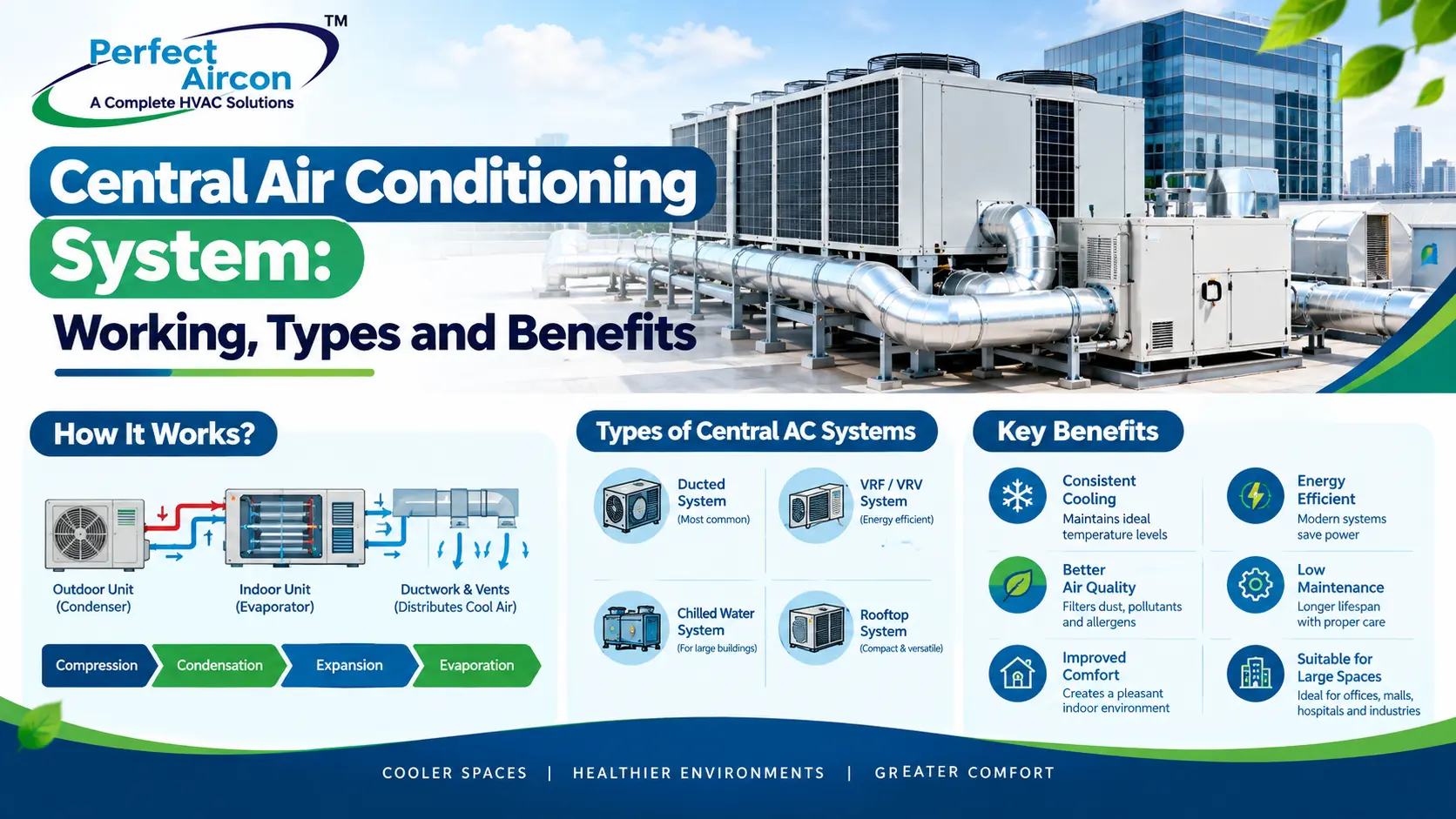
A comfortable indoor environment is important for homes, offices, hospitals, hotels, shopping malls, and industrial facilities. As buildings become larger and more sophisticated, traditional room air conditioners are not always the most practical solution. This is where a central air conditioning system becomes useful.
A central AC system is designed to cool and distribute conditioned air throughout multiple rooms or zones from a centralized setup. It can provide consistent temperature control, better air distribution, and efficient cooling for large spaces. In this guide, we will explain what is central air conditioning, how a centralized AC system works, its common types, major benefits, and factors to consider before choosing one.
What Is Central Air Conditioning?
So, what is central air conditioning in simple terms? It is an air conditioning system where cooling is produced at a central location and then distributed to different areas of a building through ducts, pipes, or other distribution systems.
Unlike a conventional split AC that generally serves one room or a specific area, a central air conditioning system can cool several rooms or larger spaces using a single coordinated system.
The term central air meaning refers to centralized cooling, where different components work together to control the temperature and indoor air conditions across a building.
A typical system may include a cooling unit, compressor, condenser, air handling unit, ductwork, filters, thermostats, and other control components. The exact configuration depends on the building size, cooling requirements, and system design.
Also Read:
Split AC Repair Service
AC Duct Manufacturing & Installation
What Does Central AC Mean?
If you are wondering what does central AC mean, it essentially means an air conditioning arrangement designed to cool a building from a central system rather than using separate AC units for every room.
For example, an office building may have several rooms, cabins, meeting areas, and common spaces. Instead of installing individual air conditioners everywhere, a properly designed centralized AC system can distribute conditioned air throughout these areas.
This approach is particularly suitable for commercial and large residential buildings where uniform cooling and centralized control are important.
How Does a Central Air Conditioning System Work?
The working principle of a central AC system is based on the refrigeration cycle. However, unlike a standalone room AC, the cooling and air distribution process is designed to serve multiple areas.
The basic working process is as follows:
1. Air Collection
Indoor air is collected through return air ducts. This air may contain heat, dust, and other airborne particles.
2. Air Filtration
The collected air passes through filters that help remove dust and particulate matter. Proper filtration also helps maintain better indoor air quality.
3. Cooling
The air passes through a cooling coil or evaporator section. Heat is removed from the air, reducing its temperature.
4. Conditioned Air Distribution
The cooled air is then supplied to different rooms through a network of ducts. Supply diffusers and grilles help distribute the air evenly.
5. Refrigeration Cycle
The refrigeration system transfers the extracted heat away from the building. The refrigerant circulates through the evaporator, compressor, condenser, and expansion device to complete the cooling cycle.
6. Return Air
After circulating through the occupied space, some air returns to the central system through return ducts. It can then be filtered and conditioned again.
Modern centralized systems can also include advanced controls that allow users to regulate temperature, airflow, and operating schedules.
Types of Central Air Conditioning Systems
Different buildings have different cooling requirements, so there is no single central AC configuration suitable for every application.
1. Centralized Split Air Conditioning System
A centralized split system generally consists of an outdoor condensing unit and an indoor air handling unit connected through refrigerant piping. Conditioned air is distributed through ductwork.
This type of system is commonly used in offices, commercial spaces, villas, and other medium-to-large buildings.
2. Packaged Central Air Conditioning System
In a packaged system, major components such as the compressor, condenser, and air handling sections are integrated into a single package or coordinated equipment arrangement.
These systems can be useful where installation space and building requirements make packaged equipment practical.
3. Chilled Water Central Air Conditioning System
Large commercial and industrial buildings may use chilled water systems. In this arrangement, a chiller produces chilled water, which circulates to air handling units or fan coil units.
The AHU uses the chilled water to cool the air before distributing it through the building.
Chilled water systems are widely considered for large facilities where centralized cooling and high-capacity operation are required.
4. VRF-Based Centralized Air Conditioning
Variable Refrigerant Flow (VRF) systems can provide centralized cooling and heating while allowing different zones to be controlled independently.
They are particularly suitable for offices, hotels, commercial buildings, and other projects where flexible zoning is important.
Benefits of a Centralized AC System
Choosing a centralized AC system can provide several advantages when the system is correctly designed and installed.
Consistent Cooling
A properly designed system can distribute conditioned air across multiple rooms and maintain a more consistent indoor temperature.
Better Space Management
Centralized equipment can reduce the need for numerous outdoor AC units around the building. This can create a cleaner and more organized appearance.
Centralized Control
Temperature settings, schedules, and operating conditions can be managed through centralized controls depending on the system configuration.
Suitable for Large Buildings
Central air conditioning is particularly useful for offices, hotels, hospitals, malls, educational institutions, and other large facilities where individual AC units may not be practical.
Improved Air Distribution
Ductwork allows conditioned air to be distributed to different rooms and zones. Properly designed ducts can help provide balanced airflow throughout the building.
Better Filtration
Central systems can incorporate multiple filtration stages depending on the application’s requirements. This can be beneficial for buildings where indoor air quality is an important consideration.
Flexible Zoning
Advanced centralized systems can support different temperature settings for different zones. This helps avoid cooling unused areas unnecessarily.
Professional Appearance
With concealed ductwork and appropriately positioned diffusers, the indoor environment can have a cleaner and more uniform appearance compared with multiple wall-mounted AC units.
Central AC vs Individual Air Conditioners
The choice between central air and individual AC units depends on the building and its cooling requirements.
Individual split ACs can be convenient for small spaces because each room can have its own independent unit. However, managing multiple outdoor units, maintenance requirements, and separate controls can become challenging in a larger building.
A centralized AC system is generally more appropriate when multiple rooms or large areas need coordinated cooling. The initial installation can be more complex, but the system can provide centralized operation, organized air distribution, and better control across larger spaces.
Where Is Central Air Conditioning Used?
Centralized AC systems are commonly considered for:
- Corporate offices
- Hotels and resorts
- Hospitals and healthcare facilities
- Shopping malls
- Restaurants and commercial buildings
- Educational institutions
- Industrial facilities
- Large residential projects
- Showrooms and retail spaces
- Conference and convention centers
The appropriate system depends on factors such as building size, occupancy, heat load, operating hours, ventilation requirements, and energy-efficiency targets.
Factors to Consider Before Choosing Central AC
Before installing a central air conditioning system, it is important to evaluate the building properly. Cooling capacity should not be selected simply according to floor area.
Important factors include building orientation, insulation, number of occupants, equipment heat load, windows, ventilation requirements, operating hours, and future expansion plans.
The duct layout also needs careful consideration. Poorly designed ductwork can result in uneven cooling, pressure losses, excessive noise, and higher energy consumption.
Professional load calculation and system design can help determine the appropriate equipment capacity and configuration.
Why Choose Perfect Aircon for Central Air Conditioning Solutions?
Selecting the right HVAC partner is important because the performance of a centralized AC system depends not only on the equipment but also on proper design, installation, commissioning, and maintenance.
Perfect Aircon provides HVAC solutions for commercial and other large-scale applications, with a focus on practical system design and reliable air conditioning performance. The right solution can be planned according to the building’s cooling load, layout, usage, and operational requirements.
Whether you are planning a new installation or upgrading an existing HVAC setup, professional consultation can help you choose a system that offers comfortable cooling, efficient operation, and long-term reliability.
Conclusion
A central air conditioning system offers a practical way to provide cooling across multiple rooms and large buildings from a coordinated system. Understanding what is central air, how centralized cooling works, and the available system types can help building owners make better HVAC decisions.
From centralized split systems and packaged units to chilled water and VRF solutions, the right choice depends on the size, design, occupancy, and cooling requirements of the building.
If you are considering a centralized AC installation, proper cooling-load calculation, equipment selection, duct design, and professional installation are essential for achieving reliable performance and efficient operation.


