
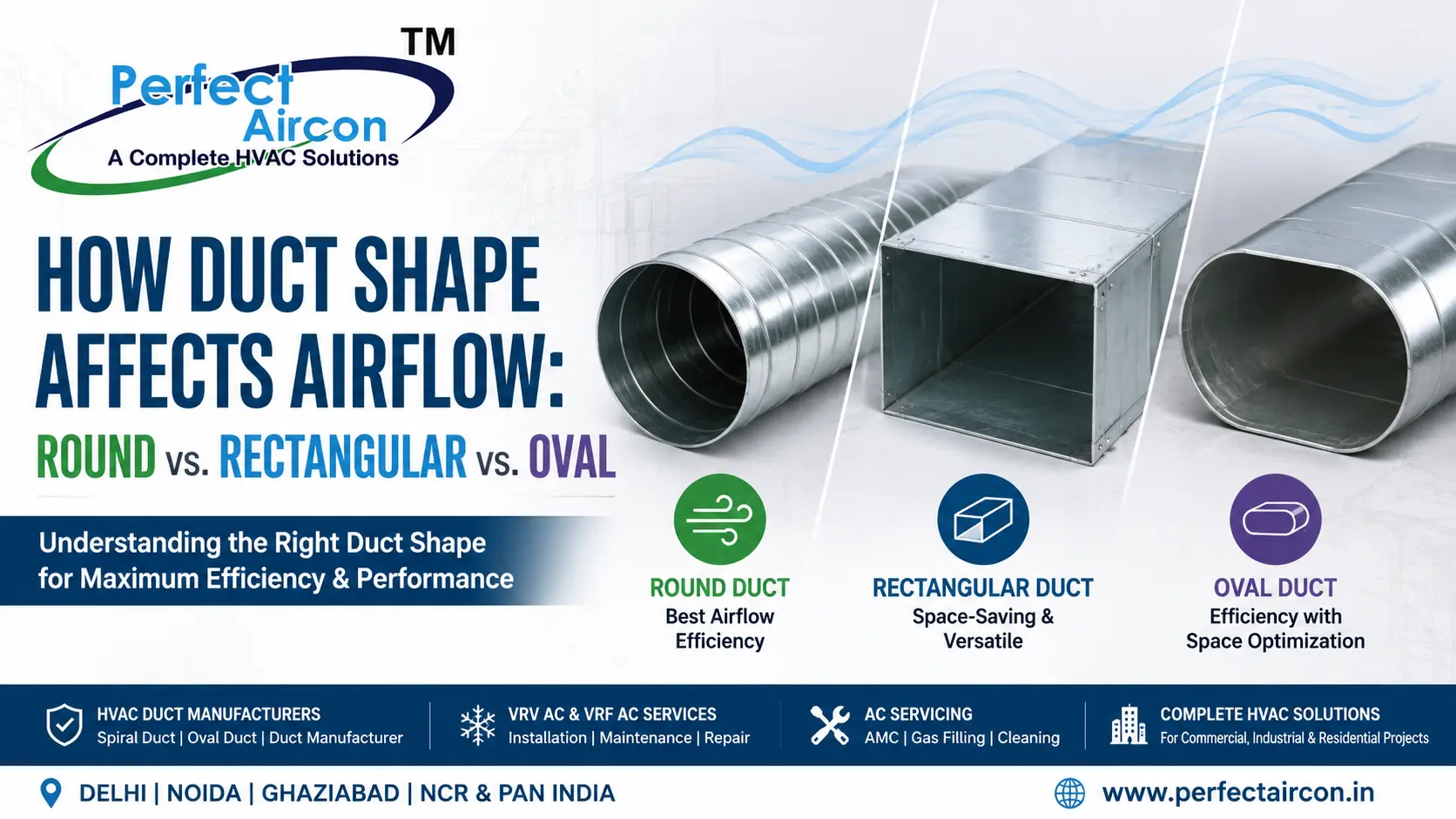
When designing an HVAC system, most people focus on air conditioning units, ventilation equipment, and cooling capacity. However, one of the most important factors that directly impacts system performance is the shape of the ductwork. The design of air ducts influences airflow efficiency, energy consumption, noise levels, and overall indoor comfort.
Understanding how different duct shapes affect airflow can help building owners, contractors, and facility managers choose the right solution for their projects. In this article, we will compare round, rectangular, and oval ducts to understand their advantages, limitations, and ideal applications.
How Duct Shape Affects Airflow in HVAC Systems
Duct shape plays a crucial role in determining the efficiency of an HVAC system. The design of the duct affects how smoothly air travels through the network, influencing airflow, pressure loss, energy consumption, and overall system performance. Round ducts generally provide the most efficient airflow because their circular shape reduces friction and turbulence. Rectangular ducting is often used where installation space is limited, but it may create higher resistance to airflow. Oval ductwork offers a balance between efficiency and space optimization. Choosing the right duct shape helps improve ventilation performance, reduce operating costs, and enhance indoor comfort.
Why Duct Shape Matters in HVAC Systems?
The primary purpose of ductwork is to transport conditioned air efficiently from HVAC equipment to different areas of a building. The shape of the duct determines how smoothly air moves through the system.
Poorly designed ducts can lead to higher pressure losses, increased energy consumption, uneven airflow distribution, and unnecessary operating costs. Therefore, selecting the right duct shape is essential for achieving optimal HVAC performance.
At Perfect Aircon, we specialize in HVAC duct manufacturing and provide high-quality spiral duct, oval duct, and customized ducting solutions for commercial, industrial, and institutional projects. We also offer VRV AC services, VRF AC services, AC servicing, ventilation solutions, and complete HVAC system support.
Read more about the best ac repair service near me

Understanding Round Ductwork
Round ducts are considered the most efficient duct shape for airflow. Their circular design allows air to move smoothly through the system with minimal resistance.
Because there are no corners inside the duct, air experiences less turbulence and friction. This results in better airflow performance and lower pressure losses compared to other duct shapes.
Many HVAC professionals often ask, “is round ductwork better than rectangular?” In most cases, the answer is yes. Round ducts typically provide better airflow efficiency and require less fan power to move air through the system.
Benefits of Round Ductwork
- Excellent airflow efficiency
- Lower energy consumption
- Reduced pressure drop
- Less air leakage
- Lower operating noise
- Longer service life
- Easier maintenance
Round sheet metal ductwork is widely used in commercial buildings, industrial facilities, shopping malls, warehouses, and manufacturing plants where efficient air movement is a priority.
The Advantages of Spiral Duct Systems
A spiral duct is a type of round duct manufactured using a continuous spiral seam. These ducts have become increasingly popular in modern HVAC projects due to their strength, durability, and superior airflow characteristics.
As a trusted HVAC duct manufacturer, Perfect Aircon provides high-quality spiral duct systems designed to deliver maximum airflow efficiency and long-term performance.
Compared to traditional ducting systems, spiral ducts offer:
- Improved structural strength
- Reduced air leakage
- Faster installation
- Better aesthetics
- Lower maintenance requirements
- Enhanced energy efficiency
This is one of the reasons why many engineers prefer spiral duct systems for modern commercial and industrial HVAC applications.
Rectangular Ducting: The Traditional Choice
Rectangular ducting has been used in HVAC installations for decades. These ducts are commonly found in offices, residential buildings, hotels, and commercial spaces where ceiling space is limited.
One of the main advantages of rectangular ducting is its ability to fit into confined spaces. The flat design allows the duct to be installed above suspended ceilings and within structural limitations.
However, rectangular ducts have certain disadvantages when compared to round ducts.
Because rectangular ducts contain corners, airflow tends to create turbulence. This turbulence increases friction, resulting in higher pressure losses and reduced efficiency.
Advantages of Rectangular Ducting
- Suitable for low ceiling spaces
- Easier to conceal
- Flexible installation options
- Commonly used in commercial buildings
Limitations of Rectangular Ducting
- Higher friction loss
- Increased energy consumption
- More air leakage opportunities
- Greater noise generation
- Additional reinforcement requirements
These factors often arise when comparing round vs rectangular duct systems.
Round vs Rectangular Duct: Which Performs Better?
The debate over round vs rectangular duct systems is common in the HVAC industry. From an airflow perspective, round ducts generally outperform rectangular ducts. Their smooth circular shape allows air to move more efficiently, reducing pressure losses and improving overall system performance.
Rectangular ducts remain useful where space constraints make round ducts impractical. However, if airflow efficiency is the primary goal, round ductwork is typically the preferred option.
Comparison of Round vs Rectangular Duct
Round Duct
- Better airflow performance
- Lower pressure loss
- Reduced noise
- Less air leakage
- More energy efficient
Rectangular Duct
- Better for limited spaces
- Easier ceiling integration
- More design flexibility
- Higher friction loss
- Increased maintenance requirements
For most large-scale HVAC installations, round sheet metal ductwork offers better long-term performance and operating efficiency.
Oval Ductwork: A Smart Alternative
Oval ductwork combines many of the advantages of both round and rectangular ducts.
An oval duct maintains a streamlined airflow path similar to a round duct while occupying less vertical space. This makes it an excellent solution for projects with height restrictions.
Many architects and HVAC consultants choose oval ductwork when they need efficient airflow without sacrificing valuable ceiling space.
Benefits of Oval Ductwork
- Better airflow than rectangular ducts
- Reduced pressure loss
- Space-saving design
- Attractive appearance
- Suitable for modern buildings
- Improved energy efficiency
As a leading oval duct manufacturer, Perfect Aircon supplies customized oval duct solutions for commercial complexes, hotels, hospitals, educational institutions, and industrial facilities.
Which Duct Shape Should You Choose?
The ideal duct shape depends on project requirements, available space, airflow demands, and budget.
Choose round ducts when:
- Airflow efficiency is the priority
- Energy savings are important
- Industrial applications are involved
- Large air volumes are required
Choose rectangular ducting when:
- Ceiling space is limited
- Architectural restrictions exist
- Installation flexibility is needed
Choose oval ductwork when:
- Both airflow performance and space optimization are important
- Modern building aesthetics are desired
- Ceiling height restrictions are present
Why Choose Perfect Aircon?
Perfect Aircon is a trusted name in HVAC solutions, serving clients across commercial, industrial, and institutional sectors. We are engaged in manufacturing high-quality HVAC ducts, spiral ducts, oval ducts, and customized ducting systems designed for efficient air distribution and long-term performance.
Our services include:
- HVAC Duct Manufacturing
- Spiral Duct Manufacturing
- Oval Duct Manufacturing
- Industrial Ventilation Solutions
- Duct Installation Services
- VRV AC Services
- VRF AC Services
- AC Servicing and Maintenance
- HVAC System Design and Support
With a focus on quality, innovation, and customer satisfaction, we deliver reliable solutions tailored to the specific needs of every project.
Conclusion
The shape of ductwork plays a critical role in determining HVAC system efficiency, airflow quality, and operating costs. While round ducts offer the highest airflow efficiency, rectangular ducting remains useful for space-constrained installations. Oval ductwork provides an excellent balance between airflow performance and space optimization.
Understanding the differences between round vs rectangular duct systems and evaluating project requirements carefully can help ensure the best HVAC performance. Whether you require spiral duct systems, oval ductwork, HVAC duct manufacturing, VRV AC services, VRF AC services, or professional AC servicing, Perfect Aircon provides comprehensive solutions designed to meet modern ventilation and air conditioning needs.