
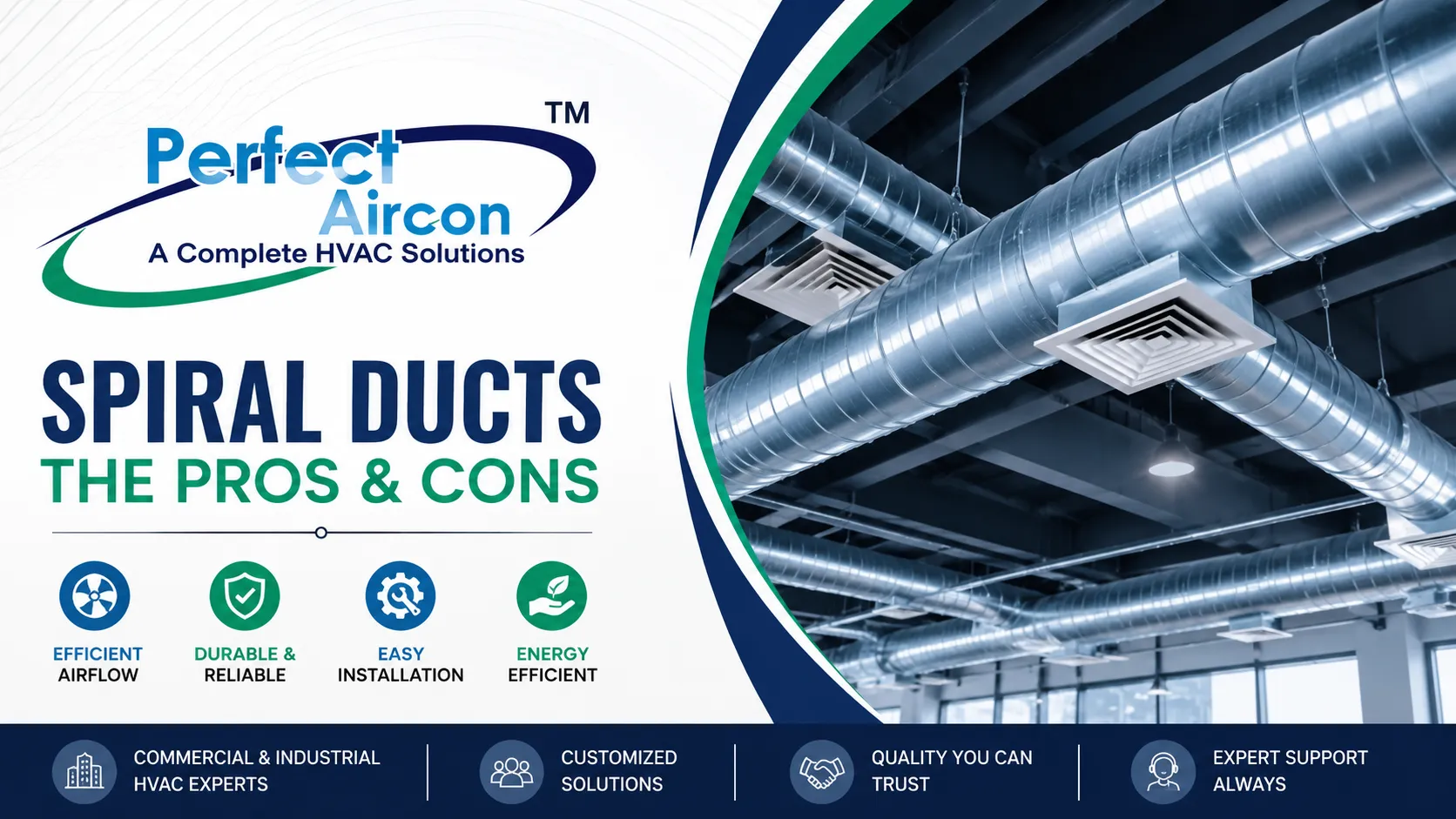
When designing an HVAC or ventilation system, ductwork plays an important role in moving conditioned air from one location to another. While rectangular ducts have traditionally been used in many commercial and industrial buildings, spiral ducts have become a popular alternative because of their strength, clean appearance, and efficient airflow characteristics.
Spiral ducting is commonly found in offices, factories, warehouses, shopping centers, restaurants, hospitals, gyms, commercial buildings, and other spaces where reliable air distribution is required. Its circular shape and spiral-seamed construction give it a distinctive appearance while also providing structural advantages.
Perfect Aircon provides HVAC and ducting solutions for commercial, industrial, and other applications. Understanding what spiral ducts are, how they work, and their advantages and limitations can help you determine whether they are suitable for your project.
What Are Spiral Ducts?
Spiral ducts are cylindrical air ducts manufactured by continuously forming and winding a strip of metal into a spiral shape. The edges of the strip are joined together to create a continuous seam along the length of the duct.
This manufacturing method gives the duct its characteristic spiral appearance and helps provide structural rigidity. Depending on the application, spiral ducts can be manufactured using galvanized steel, stainless steel, aluminum, or other suitable materials.
Unlike rectangular ductwork, which has four flat sides, spiral ducts have a circular cross-section. This shape can offer advantages in terms of airflow, strength, installation, and appearance.
Also Read: What Is a Ductable Air Conditioner?
What Is Spiral Ducting Used For?
The primary purpose of spiral ducting is to transport air through HVAC and ventilation systems. It can be used for both supply and exhaust air depending on the design of the system.
In commercial buildings, spiral ducts may distribute conditioned air from an air handling unit to different rooms or zones. In industrial environments, they can be used for general ventilation, exhaust air, dust extraction, or process-related air movement.
Restaurants, warehouses, gyms, factories, offices, retail stores, and institutional buildings can all use spiral ducting when the design and operating requirements are suitable.
The final duct size, material, thickness, insulation, fittings, and installation arrangement should be selected according to the required airflow and project conditions.
What Is Spiral Ductwork?
Spiral ductwork refers to a complete ducting arrangement made using spiral ducts and associated components. It is not limited to the straight sections of duct. A complete system may also include elbows, reducers, branches, dampers, connectors, access sections, diffusers, grilles, and other fittings.
Because spiral ducts are circular, specially designed fittings are used to change direction, connect branches, or transition between different duct sizes.
A properly designed spiral ductwork system should provide the required airflow while keeping pressure losses and leakage under control. Professional design and installation are therefore important for achieving good HVAC performance.
What Is Spiral Wound Ducting?
Spiral wound ducting is another term used for ducts manufactured using a spiral winding process. The continuous wound seam provides rigidity and contributes to the overall strength of the duct.
One of the useful characteristics of spiral wound ducting is that it can be manufactured in different diameters and thicknesses according to application requirements. The choice of material and construction depends on factors such as airflow, pressure, temperature, environment, and the type of air or material being transported.
This makes spiral wound construction suitable for a broad range of HVAC and ventilation applications.
Advantages of Spiral Ducting
Efficient Airflow
The circular shape of spiral ducting can provide smooth internal airflow compared with some duct configurations. A well-designed system can help maintain efficient air movement while minimizing unnecessary turbulence and pressure losses.
However, actual airflow performance depends on duct diameter, length, fittings, airflow velocity, system layout, and other design factors.
High Structural Strength
The spiral seam provides additional rigidity to the cylindrical duct. This can make spiral ducts resistant to deformation during handling and installation.
Their strength makes them suitable for many commercial and industrial environments where the ductwork may be exposed or installed in areas with demanding operating conditions.
Attractive Appearance
One reason architects and interior designers often consider spiral ductwork is its appearance. When installed in exposed ceilings, the circular metal ducts can become part of the building’s visual design.
Restaurants, cafés, retail stores, offices, gyms, and modern commercial spaces may leave spiral ducts exposed rather than hiding them above a false ceiling. This can create an industrial or contemporary appearance.
Easy Installation
Spiral ducts can be relatively convenient to install because their circular sections and fittings can be assembled using suitable connectors and supports.
Their lightweight construction, depending on material and size, can also make handling easier. Proper support spacing and installation practices are still necessary to maintain system stability.
Good Material Options
Spiral ducts can be manufactured from different materials to suit different environments. Galvanized steel is widely used for general HVAC applications, while stainless steel may be considered for environments requiring greater corrosion resistance or specific hygiene requirements.
Aluminum can also be selected for applications where low weight and corrosion resistance are important.
Customizable Sizes
Spiral ducting can be manufactured in various diameters and lengths. This allows the system designer to select suitable dimensions according to airflow requirements and available installation space.
Custom fabrication can also help accommodate unusual building layouts and specific project requirements.
Disadvantages of Spiral Ductwork
Although spiral ducts offer several advantages, they are not suitable for every HVAC project.
Requires More Vertical Space
The circular shape of spiral ducts can require more vertical clearance than some rectangular duct configurations when the same airflow capacity needs to be accommodated in a restricted ceiling space.
This can be an important consideration in buildings with low ceiling heights or congested service areas.
Exposed Ducts Need Proper Finishing
When spiral ductwork is installed visibly, its appearance becomes part of the interior environment. Scratches, dents, poor joints, or inconsistent finishing may therefore be more noticeable.
For exposed installations, proper fabrication, handling, painting or finishing, and installation become particularly important.
Insulation May Be Required
Depending on the application and surrounding environment, spiral ducts may require thermal or acoustic insulation. For conditioned air systems, insulation can help reduce unwanted heat transfer and condensation.
Adding insulation can increase the overall diameter of the installed ductwork and should therefore be considered during the design stage.
Not Always Ideal for Every Layout
Circular ductwork works very well in many applications, but certain buildings may have restricted spaces where rectangular ductwork provides easier routing.
The correct choice should therefore be based on the actual building layout rather than selecting spiral ducts solely because of their appearance.
Spiral Ducting vs Rectangular Ductwork
The choice between spiral ducting and rectangular ductwork depends on project requirements.
Spiral ducts provide a smooth circular airflow path, strong construction, and an attractive appearance for exposed installations. They can be particularly suitable where aesthetics and visible mechanical services are part of the design.
Rectangular ducts, on the other hand, can sometimes make better use of limited ceiling height because their dimensions can be customized in two directions. This can be useful in congested commercial buildings.
Neither option is universally better. HVAC engineers should consider airflow, pressure loss, available space, insulation requirements, installation cost, maintenance, and architectural preferences before selecting the duct type.
Applications of Spiral Ducts
Spiral ducts are used across a wide range of sectors. In commercial buildings, they can be used for air supply and return systems. Offices, shopping centers, restaurants, hotels, schools, and gyms may use spiral ductwork for ventilation and air conditioning.
Industrial facilities may use them for factory ventilation, exhaust systems, air distribution, and selected dust-handling applications. Warehouses can also use spiral ducts where large open areas require effective air movement.
They are particularly popular in spaces where the ductwork remains visible because the clean cylindrical design can complement modern interiors.
How to Choose the Right Spiral Duct?
Selecting the correct spiral duct requires more than choosing a diameter. The required airflow, operating pressure, temperature, material, duct length, installation environment, and insulation requirements should all be evaluated.
The type of air being transported is also important. General comfort-air applications may have different requirements from industrial exhaust or process ventilation systems.
The duct thickness and connection method should be appropriate for the operating conditions. Proper sizing is equally important because an incorrectly sized duct can affect airflow, noise levels, energy consumption, and overall system performance.
Why Choose Perfect Aircon for Spiral Ducting?
Perfect Aircon provides ducting and HVAC solutions designed around the requirements of commercial and industrial projects. The company can assist with spiral ducting requirements for air-conditioning, ventilation, exhaust, and air distribution applications.
From straight duct sections to required fittings and customized configurations, the ductwork can be planned according to the project’s dimensions and HVAC requirements. Proper material selection, fabrication, installation, and system planning are important for achieving dependable long-term performance.
For customers looking for spiral ductwork or spiral wound ducting, working with an experienced HVAC and ducting provider can make the selection and installation process more straightforward.
Conclusion
Spiral ducts offer a practical combination of strength, airflow performance, customization, and modern appearance. Their circular design makes them particularly attractive for exposed HVAC installations, while their spiral-wound construction provides useful structural rigidity.
At the same time, factors such as ceiling clearance, insulation requirements, building layout, and project budget should be considered before choosing them. A well-designed system is more important than simply selecting a particular duct shape.
Whether you are developing an office, restaurant, factory, warehouse, commercial complex, or institutional building, spiral ducting can be an effective option for air distribution and ventilation when properly designed and installed.
Perfect Aircon offers HVAC and ducting solutions for commercial and industrial applications, helping customers select suitable spiral ductwork and related systems according to their project requirements.