
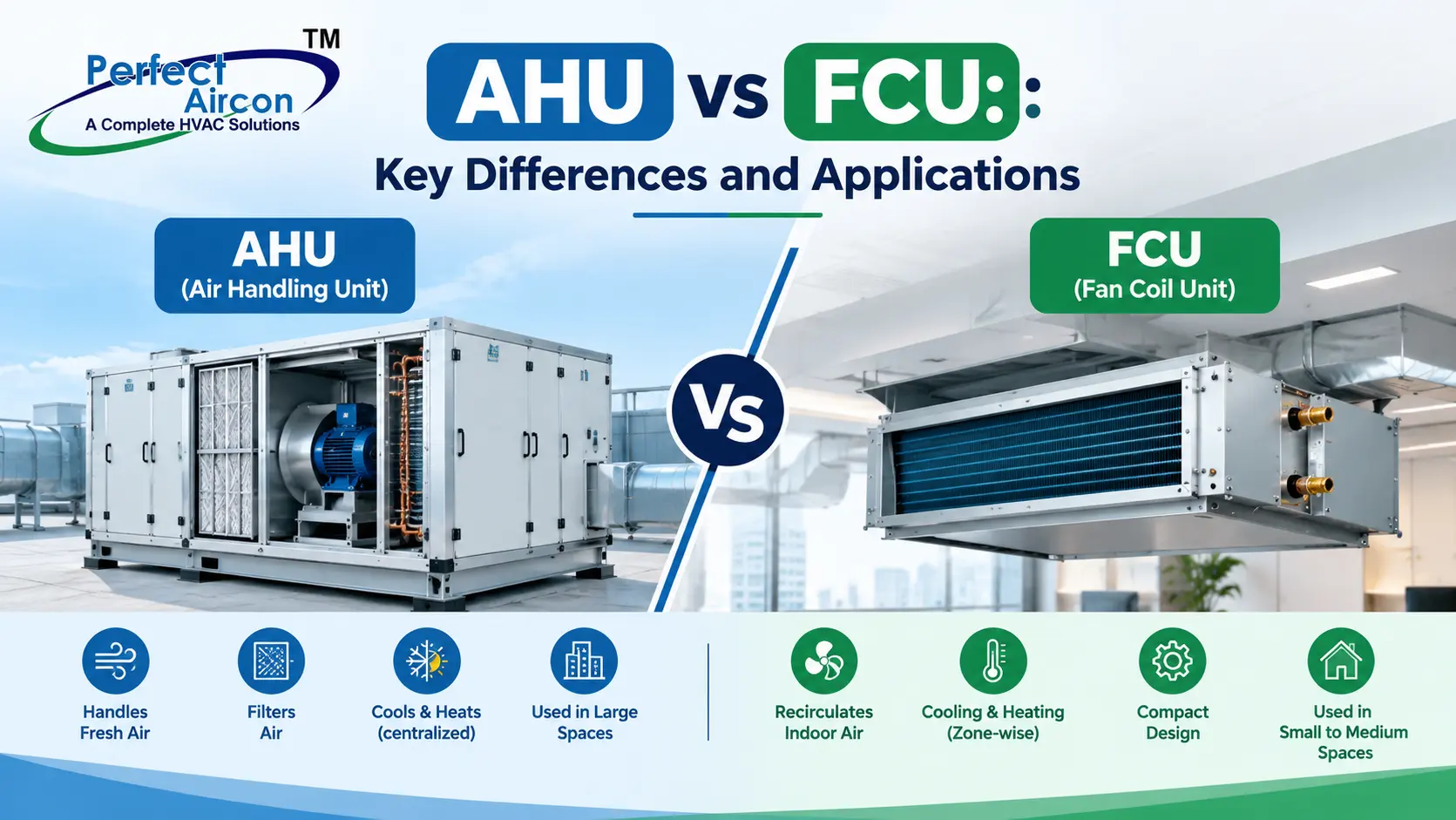
Heating, ventilation and air conditioning (HVAC) systems play an important role in maintaining comfortable, healthy and controlled indoor environments. In commercial buildings, offices, hospitals, hotels, malls and industrial facilities, two commonly used air-conditioning components are Air Handling Units (AHUs) and Fan Coil Units (FCUs).
Although both systems are designed to condition indoor air, they differ significantly in their construction, capacity, air distribution, ventilation capabilities and applications. Understanding the difference between them can help building owners, consultants and facility managers select the right solution for their HVAC requirements.
In this guide, we will explain AHU vs FCU, including their working principles, applications and the major differences between a fan coil unit vs air handling unit.
What Is an AHU in HVAC?
An Air Handling Unit, commonly known as an AHU, is a central HVAC equipment used to condition and distribute air throughout a building. The AHU meaning HVAC is essentially an air-handling system that receives air, filters it, regulates its temperature and humidity when required, and supplies conditioned air through ductwork.
An AHU can handle large volumes of air and is generally installed in a dedicated mechanical room, rooftop area or service space. Depending on the building requirements, an AHU can include components such as filters, cooling coils, heating coils, fans, dampers, humidifiers and other air-control devices.
In AHU HVAC systems, conditioned air is distributed to different rooms or zones through a network of supply and return air ducts. This makes AHUs suitable for large spaces where centralized air conditioning and ventilation are required.
Also Read: What Is an AHU? Working, Types and Applications
How Does an AHU Work?
The basic working principle of an AHU is relatively straightforward. Return air from the building is collected through return ducts and mixed with a controlled amount of fresh outdoor air. The air then passes through filters to remove dust and other airborne particles.
After filtration, the air moves across a cooling or heating coil depending on the required indoor temperature. A fan then pushes the conditioned air through supply ducts to different areas of the building.
Modern AHUs can also include humidity control, energy recovery and advanced filtration systems. Their configuration depends on factors such as building size, occupancy, indoor air quality requirements and HVAC design.
What Is an FCU in HVAC?
So, what is FCU in HVAC? FCU stands for Fan Coil Unit. It is a compact air-conditioning device that contains a fan and a heat-exchange coil to provide heating or cooling to a specific room or zone.
An FCU HVAC system typically uses chilled water or hot water flowing through a coil. The fan draws indoor air across the coil, where the air is cooled or heated before being circulated back into the room.
Unlike a large AHU, an FCU is usually installed close to the occupied space. It can be placed in a ceiling, wall, floor or other suitable location depending on the unit design.
FCUs are commonly used in hotels, apartments, offices, hospitals, retail spaces and other buildings where individual room or zone control is important.
AHU vs FCU: Key Differences
The main difference between an AHU and an FCU is their size, capacity, air distribution method and intended application.
| Feature | AHU | FCU |
|---|---|---|
| Full Form | Air Handling Unit | Fan Coil Unit |
| Capacity | Generally higher | Generally lower |
| Installation | Usually central/dedicated area | Usually near the conditioned space |
| Air Distribution | Uses ductwork | Usually supplies air directly into the room |
| Fresh Air | Can handle and distribute fresh air | Usually does not provide primary fresh-air ventilation |
| Application | Large buildings and centralized HVAC | Individual rooms or smaller zones |
| Filtration | Can accommodate advanced filtration | Generally uses simpler filtration |
| Control | Centralized or zone-based | Mostly local room-level control |
| Maintenance | Requires planned central maintenance | Relatively localized maintenance |
Fan Coil Unit vs Air Handling Unit: Air Distribution
One of the most important differences between a fan coil unit vs air handling unit is how conditioned air is distributed.
AHUs are generally connected to supply and return duct systems. This allows one unit to condition and distribute large quantities of air to multiple areas. The duct network can also include dampers and controls to regulate airflow between zones.
FCUs, on the other hand, are usually installed directly within or close to the space they serve. The fan circulates conditioned air locally, making FCUs suitable for room-by-room temperature control.
Ventilation and Fresh Air
Ventilation is another important consideration when comparing AHU and FCU systems.
AHUs can be designed to introduce, filter and condition outdoor fresh air. This makes them useful in buildings where ventilation and indoor air quality are major requirements.
A typical FCU primarily recirculates and conditions the air already present in the room. It is not normally designed to serve as the main source of outdoor ventilation. For buildings requiring controlled fresh-air ventilation, an FCU may therefore need to work alongside a dedicated fresh-air or ventilation system.
Applications of AHU
AHUs are commonly used where large quantities of conditioned air and centralized ventilation are required. Typical applications include:
- Commercial office buildings
- Shopping malls and retail complexes
- Hospitals and healthcare facilities
- Hotels and large residential buildings
- Airports and transportation facilities
- Industrial and manufacturing facilities
- Educational institutions
- Large conference and convention spaces
AHUs are particularly useful when multiple rooms or zones need to be served from a centralized HVAC system.
Applications of FCU
FCUs are suitable for applications where localized cooling or heating and individual temperature control are required. Common applications include:
- Hotel rooms
- Apartments
- Individual offices
- Retail stores
- Small commercial spaces
- Hospital rooms
- Restaurants
- Residential buildings
Because FCUs are compact and can be controlled individually, they provide flexibility when different rooms require different temperature settings.
Can AHU and FCU Work Together?
Yes. AHUs and FCUs can work together as part of the same HVAC design.
For example, an AHU can be used to provide treated fresh air to different areas, while individual FCUs handle local cooling requirements. This arrangement can provide both ventilation and room-level temperature control.
Such combined systems are useful in hotels, offices, hospitals and other buildings where fresh-air requirements and individual zone control need to be addressed simultaneously.
Which One Should You Choose: AHU or FCU?
The choice between an AHU and an FCU depends on the building’s size, HVAC design, ventilation requirements, zoning needs and available installation space.
An AHU is generally considered when the project requires centralized air handling, larger airflow volumes, ducted air distribution and controlled ventilation. An FCU is more appropriate when localized cooling, compact installation and individual room control are the main requirements.
In many modern buildings, the two systems are not necessarily competing alternatives. They can be complementary components within a properly designed HVAC system.
Conclusion
Understanding AHU vs FCU is important when planning an efficient HVAC system. AHUs are designed for centralized air handling, ventilation and distribution, while FCUs provide localized heating or cooling for individual rooms or zones.
The right choice depends on factors such as building size, occupancy, ventilation requirements, temperature-control needs, ductwork and overall HVAC design. For larger commercial and industrial projects, AHUs can provide centralized air treatment and distribution, while FCUs can offer convenient zone-level control.
At Perfect Aircon, professional HVAC planning and equipment selection can help ensure that the air-conditioning system matches the technical and operational requirements of the building. A properly designed system can improve indoor comfort, airflow management and overall HVAC performance.