A reliable cooling system is an important for maintaining comfortable indoor environments and stable operating conditions in commercial and industrial facilities. From shopping malls and hospitals to manufacturing plants and office buildings, efficient cooling supports equipment performance, employee comfort, and day-to-day operations. One of the most important components used for large-scale cooling is an HVAC chiller.
But what is a chiller, how does it work, and which type is suitable for your facility? Understanding the basics can help businesses choose an appropriate cooling solution based on their capacity requirements, energy consumption, and operating conditions.
In this guide, we will explain the chiller working principle, explore the different types of chillers in HVAC, and discuss their applications and benefits.
What Is a Chiller in HVAC?
An HVAC chiller is a cooling machine that removes heat from water or another suitable fluid and circulates the cooled fluid through a building or industrial process. The chilled water transfers heat from the required area or equipment, allowing the chiller to remove that heat and maintain the desired temperature.
Unlike conventional air conditioners that generally cool indoor air directly, many central HVAC systems use chillers to produce chilled water. This water travels through pipes to air handling units (AHUs), fan coil units, or process equipment, where heat is transferred from the air or machinery to the water.
A chiller unit typically includes a compressor, evaporator, condenser, and expansion device in a vapour-compression system. Some systems use absorption technology instead of a conventional compressor.
Chillers are commonly installed in commercial buildings, hospitals, hotels, data centres, pharmaceutical facilities, and industrial plants that require dependable cooling.
Also Read: Chiller Plant Supply & Installation
How Does a Chiller Work? Chiller Working Principle
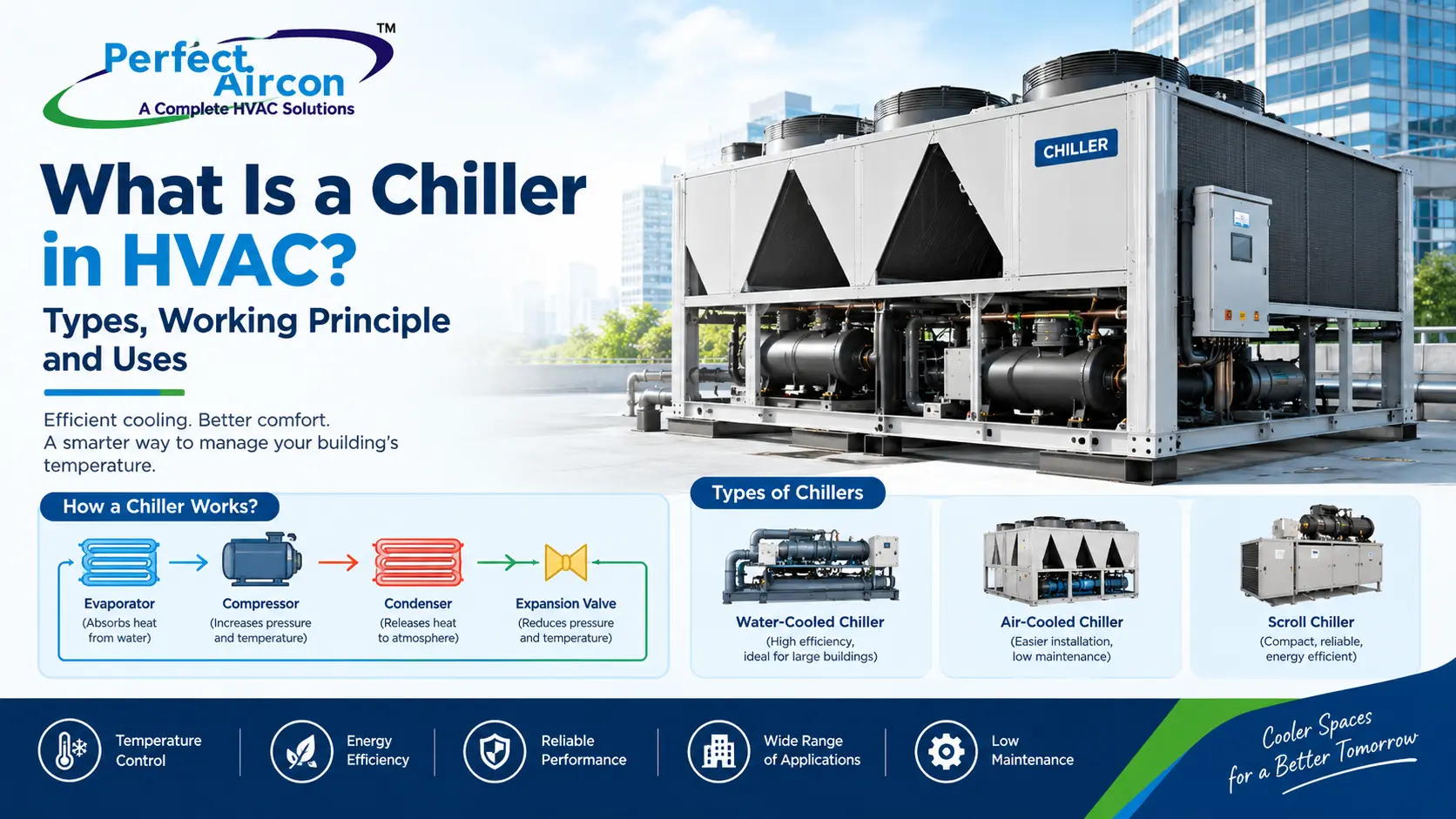
The chiller working principle is based on heat transfer. A typical vapour-compression chiller uses refrigerant to absorb heat from chilled water and release that heat through a condenser.
The cooling process involves four main stages.
1. Evaporation
Warm return water enters the evaporator, where it transfers heat to the refrigerant. The refrigerant absorbs this heat and evaporates into a gas. As heat leaves the water, the water becomes cooler and is circulated back to the building or process.
2. Compression
The compressor draws in the refrigerant vapour and increases its pressure and temperature. This prepares the refrigerant to release the absorbed heat through the condenser.
3. Condensation
The hot, high-pressure refrigerant enters the condenser and releases heat. In an air-cooled chiller, fans move ambient air across the condenser coils. In a water-cooled chiller, water removes heat from the refrigerant, usually transferring it to a cooling tower.
As the refrigerant loses heat, it condenses into a liquid.
4. Expansion
The liquid refrigerant passes through an expansion valve or another metering device. Its pressure and temperature decrease, allowing it to absorb heat again when it returns to the evaporator.
This cycle continues while cooling is required.
In simple terms, a chiller does not create cold directly. It removes heat from water and transfers that heat to the surrounding air or a separate cooling-water circuit.
Types of Chillers in HVAC
Selecting the right equipment depends on the required cooling capacity, available installation space, energy efficiency, water availability, and maintenance requirements. The main types of chillers in HVAC include the following.
1. Air-Cooled Chiller
An air-cooled chiller uses ambient air to remove heat from the refrigerant through condenser coils and fans. It does not normally require a cooling tower or a separate condenser-water circuit.
Key benefits:
- Relatively straightforward installation.
- No cooling tower water circuit required.
- Suitable for facilities with limited water availability.
- Generally simpler external cooling-system arrangements.
Air-cooled chillers are commonly used in offices, retail spaces, hotels, smaller industrial facilities, and commercial buildings. Their performance can be affected by high outdoor temperatures, airflow restrictions, and condenser maintenance.
2. Water-Cooled Chiller
A water-cooled chiller uses water in its condenser to transfer heat away from the refrigerant. The heated condenser water commonly flows to a cooling tower, where the heat is released into the atmosphere.
Key benefits:
- Suitable for large cooling loads.
- Can offer strong energy performance in appropriately designed systems.
- Well suited to facilities with continuous cooling requirements.
Water-cooled chillers are frequently installed in large hospitals, manufacturing plants, hotels, commercial complexes, and other facilities with substantial cooling demand. However, they generally require additional equipment, water treatment, and regular maintenance of the condenser-water system.
3. Screw Chiller
A screw chiller uses rotating screw-shaped rotors to compress refrigerant. Depending on the design, screw compressors can provide reliable operation across a range of cooling loads.
Key benefits:
- Suitable for medium-to-large cooling applications.
- Can provide stable operation under varying loads.
- Available in air-cooled and water-cooled configurations.
Screw chillers are often considered for industrial facilities, commercial buildings, and process-cooling applications where dependable cooling capacity is important.
4. Centrifugal Chiller
A centrifugal chiller uses a rotating impeller to increase refrigerant pressure. These chillers are commonly designed for large cooling capacities and central plant applications.
Key benefits:
- Suitable for high-capacity cooling systems.
- Can deliver efficient operation when correctly selected and controlled.
- Commonly used in large central HVAC plants.
Airports, large hospitals, shopping malls, universities, and high-rise commercial buildings may use centrifugal chillers where cooling demand justifies their installation.
5. Absorption Chiller
An absorption chiller uses heat energy rather than a conventional mechanical compressor to drive its cooling cycle. Depending on the design, it may use steam, hot water, direct-fired heat, or recovered waste heat.
Key benefits:
- Can make use of available waste heat.
- May reduce dependence on electrically driven compression for the cooling cycle.
- Can be useful in facilities with suitable thermal-energy sources.
Absorption chillers are used in selected industrial plants, cogeneration facilities, and large buildings where the required heat source is available. Their suitability depends on the overall system design and operating conditions.
Major Components of a Chiller Machine
Understanding the main components of a chiller machine helps facility managers evaluate equipment specifications and plan maintenance.
- Compressor: Raises refrigerant pressure and circulates it through the refrigeration cycle.
- Evaporator: Transfers heat from the chilled water or process fluid to the refrigerant.
- Condenser: Releases the absorbed heat to air or condenser water.
- Expansion valve: Regulates refrigerant flow and reduces its pressure before it enters the evaporator.
- Pumps: Circulate chilled water and, where applicable, condenser water.
- Controls and sensors: Monitor operating conditions and regulate cooling performance.
- Heat exchangers: Transfer heat between fluids and refrigerants in the relevant parts of the system.
The exact components and configuration vary according to chiller technology, capacity, and manufacturer.
Applications and Uses of HVAC Chillers
Chillers support both building comfort and industrial processes. Their applications extend beyond conventional air conditioning.
Commercial Buildings
Offices, hotels, shopping malls, convention centres, and large retail facilities use chillers to supply chilled water to central air-conditioning systems.
Hospitals and Healthcare Facilities
Healthcare buildings require carefully controlled indoor environments. Chillers can support cooling for patient areas, laboratories, diagnostic facilities, and other temperature-sensitive spaces, subject to the facility’s engineering requirements.
Industrial Manufacturing
Manufacturing processes often generate heat that must be removed to maintain production quality and equipment reliability. A chiller unit can provide process cooling for machinery, production lines, and selected manufacturing operations.
Pharmaceutical and Food Processing
Some pharmaceutical production areas, food-processing operations, and storage facilities require controlled temperatures. Chillers can help meet these requirements when integrated with an appropriately designed temperature-control system.
Data Centres
Servers and networking equipment generate substantial heat. Chillers may form part of a larger cooling system designed to maintain acceptable operating conditions and support reliable IT performance.
Plastics and Other Process Industries
Plastic moulding, laser equipment, printing, and other industrial processes may require consistent cooling. The required chiller capacity depends on the heat load, process temperature, and operating schedule.
Benefits of Installing the Right Chiller Unit
Choosing a properly sized and designed chiller can deliver several operational benefits.
1. Consistent temperature control: Chillers help maintain stable water temperatures for building cooling and industrial processes.
2. Improved operational reliability: Correctly selected equipment supports dependable cooling for machinery, facilities, and temperature-sensitive operations.
3. Energy management: Efficient compressors, suitable operating controls, variable-speed technology, and proper system design can help reduce energy consumption.
4. Flexible applications: Chillers are available in different capacities and configurations to suit a wide range of commercial and industrial requirements.
5. Centralised cooling: A central chiller plant can serve multiple areas or pieces of equipment through a connected chilled-water distribution network.
Actual performance and savings depend on system design, climate, operating load, maintenance, and equipment selection.
How to Choose the Right Chiller for Your Facility
Before purchasing a chiller, assess the following factors:
- Cooling capacity: Calculate the actual heat load and select suitable equipment without unnecessary oversizing.
- Chiller type: Compare air-cooled, water-cooled, screw, centrifugal, and absorption options according to your requirements.
- Energy efficiency: Review efficiency ratings at expected operating conditions rather than relying on a single performance figure.
- Installation space: Check equipment dimensions, ventilation, access for maintenance, and plant-room requirements.
- Water availability: Consider water consumption, water treatment, and cooling-tower requirements where applicable.
- Maintenance and service: Evaluate spare-parts availability, service support, warranty terms, and long-term operating costs.
- Control requirements: Check whether the system can accommodate variable cooling demand and integrate with building-management controls.
Consulting an experienced HVAC professional can help you compare suitable configurations and estimate the total cost of ownership.
Why Choose Perfect Aircon for HVAC Cooling Solutions?
Selecting suitable HVAC equipment requires attention to cooling capacity, installation conditions, energy performance, and long-term operating needs. Perfect Aircon can be considered as a point of contact for discussing your commercial or industrial air-conditioning requirements and identifying an appropriate solution.
Before finalising a chiller installation, evaluate the facility’s cooling load, operating schedule, available utilities, and maintenance needs. A properly planned HVAC system can support consistent cooling and help improve overall operational efficiency.
Contact Perfect Aircon to discuss your project requirements and explore suitable HVAC cooling options. Confirm the available chiller models, installation services, technical support, and service coverage directly with the company.
Also Read: Central Air Conditioning System: Working, Types and Benefits
Frequently Asked Questions (FAQs)
1. What is a chiller used for in HVAC?
An HVAC chiller removes heat from water or another fluid and supplies the cooled fluid to air-conditioning equipment or industrial processes. It is widely used in commercial buildings and industrial facilities.
2. What is the chiller working principle?
A typical vapour-compression chiller absorbs heat in the evaporator, compresses the refrigerant vapour, releases heat through the condenser, and reduces refrigerant pressure through an expansion device. This cycle repeats to provide cooling.
3. What are the main types of chillers in HVAC?
The main categories include air-cooled, water-cooled, screw, centrifugal, and absorption chillers. These categories describe different cooling arrangements or technologies and may overlap.
4. What is the difference between an air-cooled and a water-cooled chiller?
An air-cooled chiller releases heat directly to outdoor air, while a water-cooled chiller uses condenser water, commonly connected to a cooling tower. The best option depends on capacity, climate, water availability, and operating costs.
5. How do I select the right chiller machine?
Consider the required cooling capacity, operating temperatures, energy efficiency, installation space, water availability, maintenance needs, and total ownership cost. Professional cooling-load calculations help determine the appropriate size and configuration.
Conclusion
An HVAC chiller is an important cooling solution for buildings and industrial processes that require reliable temperature control. Understanding the chiller working principle, the available types of chillers in HVAC, and their applications makes it easier to compare equipment and plan an effective cooling system.
Whether you are evaluating an air-cooled chiller for a commercial building or a water-cooled chiller for a large industrial facility, the right choice depends on your cooling load, energy requirements, available utilities, and long-term operating conditions. Work with an experienced HVAC provider to assess your requirements and select a suitable chiller unit for your application.