Heating, ventilation, and air conditioning (HVAC) systems are an essential part of modern commercial buildings. They help maintain comfortable indoor temperatures, control humidity, improve air circulation, and support better indoor air quality. From offices and shopping malls to hospitals, hotels, factories, and large institutional buildings, the right HVAC system can have a major impact on comfort, energy consumption, and operating costs.
Choosing an HVAC system for a commercial property is not as simple as selecting an air conditioner. Building size, occupancy, room usage, ventilation requirements, climate, energy efficiency, and available installation space all need to be considered. This is why different types of commercial building HVAC systems are available for different applications.
Perfect Aircon provides HVAC solutions for commercial and industrial applications, helping businesses select systems according to their building requirements. In this guide, we will discuss the major types of HVAC systems used in commercial buildings and where each system can be suitable.
What Is a Commercial HVAC System?
A commercial HVAC system is designed to provide heating, cooling, ventilation, and air distribution for non-residential buildings. Unlike residential air-conditioning systems, commercial systems often need to handle larger spaces, higher occupancy levels, multiple zones, and varying cooling loads.
A typical commercial HVAC installation may include air-conditioning equipment, chillers, air handling units, ductwork, ventilation systems, pumps, controls, and other supporting components. The exact configuration depends on the building and its operational requirements.
For example, a small office may need a relatively simple system, while a shopping mall or hospital may require a centralized HVAC arrangement with multiple air-handling units and independently controlled zones.
Also Read: What is HVAC? Structure Principles and Documents about HVAC System
Split HVAC Systems
Split systems are among the simpler options used in smaller commercial spaces. These systems generally consist of an indoor unit and an outdoor condensing unit connected through refrigerant piping.
They can be suitable for small offices, retail shops, clinics, restaurants, and other spaces where individual room or zone control is required. One advantage is that different rooms can have separate temperature controls.
However, for large commercial buildings with many rooms and high cooling requirements, a conventional split arrangement may become less practical because multiple outdoor units can require considerable installation space.
VRF and VRV HVAC Systems
Variable Refrigerant Flow (VRF) systems are increasingly used in modern commercial buildings because they offer flexible zoning and individual temperature control. A VRF system can connect multiple indoor units to one or more outdoor units, allowing different areas of a building to operate at different temperatures.
These systems are commonly used in offices, hotels, restaurants, hospitals, retail buildings, and other multi-zone applications.
One of the important advantages of VRF technology is its ability to adjust refrigerant flow according to the actual cooling or heating requirement of each indoor zone. This can help improve energy efficiency when compared with systems that operate at a constant capacity regardless of changing demand.
Central Air Conditioning Systems
Central air-conditioning systems are designed to cool larger commercial spaces through a centralized arrangement. Conditioned air is distributed to different areas through a network of ducts.
A central system may include an air handling unit, cooling equipment, ductwork, filters, controls, and other components. Because air can be distributed throughout multiple rooms, this type of system is commonly considered for offices, hotels, educational buildings, hospitals, shopping centers, and other large facilities.
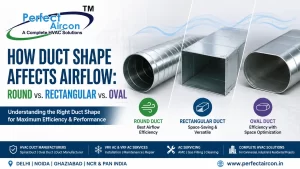
Proper duct design is particularly important. Poorly designed ductwork can increase pressure losses and affect airflow distribution. Components such as spiral ducting and rectangular ductwork may be selected according to the building layout and HVAC requirements.
Chiller-Based HVAC Systems
Chiller systems are widely used for large commercial and institutional buildings where substantial cooling capacity is required. Instead of directly circulating refrigerant to every conditioned room, a chiller produces chilled water that is circulated through the building.
The chilled water is typically supplied to air handling units or fan coil units, where heat is removed from the building’s air. The conditioned air is then distributed through the appropriate ventilation system.
Chiller-based systems can be suitable for large offices, hospitals, hotels, shopping malls, airports, universities, and industrial facilities.
Depending on the project, chillers may be air-cooled or water-cooled. The selection depends on factors such as building size, available space, water availability, climate, efficiency requirements, and project budget.
Rooftop HVAC Units
Rooftop units, commonly known as RTUs, are packaged HVAC systems installed on the roof of a commercial building. They combine several components into a single unit, which can simplify installation and reduce the amount of indoor mechanical space required.
RTUs are often used in retail stores, warehouses, restaurants, supermarkets, and single-story commercial buildings. The system can supply conditioned air through ductwork to different areas of the building.
Since the equipment is located outdoors, maintenance access and roof structural requirements need to be considered during the design stage.
Packaged HVAC Systems
Packaged HVAC systems contain major components such as the compressor, condenser, evaporator, and air-handling components within a single housing or packaged configuration.
These systems can be useful where a compact HVAC arrangement is preferred. They are commonly used for commercial spaces such as restaurants, small offices, retail stores, and other buildings with moderate cooling requirements.
Packaged systems can simplify installation because many major components are supplied as an integrated unit.
Fan Coil Unit Systems
Fan coil units, or FCUs, are commonly used as part of larger centralized HVAC arrangements. An FCU generally contains a fan and a heat-exchange coil through which chilled or heated water passes.
FCUs can provide localized temperature control for individual rooms or zones. They are frequently found in hotels, offices, hospitals, apartments, and commercial buildings.
The FCU itself does not necessarily represent the complete HVAC system. It can work together with chillers, boilers, pumps, cooling towers, air handling systems, and ventilation equipment.
Air Handling Unit-Based Systems
Air Handling Units (AHUs) are an important part of many large commercial HVAC systems. An AHU conditions and distributes air throughout a building and can include components such as filters, cooling coils, heating coils, fans, dampers, and control systems.
AHUs can be designed to handle large quantities of air and are particularly useful where ventilation and indoor air quality are important considerations.
Hospitals, shopping malls, hotels, offices, airports, and industrial facilities may use AHU-based systems depending on their specific requirements.
Industrial HVAC Systems
Commercial and industrial facilities often have significantly different HVAC requirements. Industrial HVAC systems may need to handle large floor areas, high heat loads, process-related heat, dust, fumes, humidity, and continuous operating schedules.
Factories, warehouses, manufacturing units, pharmaceutical facilities, and processing plants may require specialized HVAC arrangements. The system may include ventilation equipment, air handling units, exhaust systems, cooling equipment, filtration, and temperature or humidity controls.
In industrial environments, HVAC design should consider not only human comfort but also process requirements and workplace conditions.
How to Choose the Right HVAC System for a Commercial Building?
There is no single HVAC system that is ideal for every commercial building. The right choice depends on several factors.
Building size and layout are among the first considerations. A small office may work well with split or VRF systems, while a large shopping center may require chillers and AHUs.
Cooling load is another major factor. Equipment should be selected according to the actual heat load rather than simply choosing a larger capacity. Oversized equipment can result in inefficient operation and poor humidity control.
Zoning requirements should also be considered. If different areas have different occupancy schedules or temperature requirements, a VRF or zoned centralized system may provide better control.
Ventilation and indoor air quality are particularly important in crowded commercial spaces. The HVAC design should provide suitable fresh-air ventilation and filtration according to the building’s application and applicable requirements.
Energy efficiency and operating cost should also be evaluated over the expected life of the system. A system with a higher initial cost may sometimes offer lower energy consumption and operating expenses over time.
Importance of Proper HVAC Installation
Even a high-quality HVAC system cannot perform efficiently if it is poorly installed. Correct equipment selection, refrigerant piping, duct sizing, insulation, electrical connections, airflow balancing, drainage, and control configuration all influence system performance.
For ducted systems, proper sealing and insulation are especially important because air leakage and unwanted heat gain can reduce efficiency. Regular maintenance is equally important for maintaining filters, coils, fans, refrigerant circuits, and other components.
Conclusion
Different commercial buildings require different approaches to heating, cooling, and ventilation. Split systems can be practical for smaller spaces, while VRF systems offer flexible zoning for multi-room buildings. Central air-conditioning and chiller-based systems can handle larger facilities, while rooftop and packaged systems offer compact solutions for selected applications. AHUs and FCUs are often integrated into larger centralized systems, while specialized industrial HVAC systems are designed for demanding manufacturing and process environments.
The best commercial building HVAC systems are those that are selected after considering the building’s size, occupancy, cooling load, ventilation requirements, energy goals, and operating conditions.
Perfect Aircon provides HVAC solutions for commercial and industrial applications, including air-conditioning, ventilation, ducting, and related systems. A properly planned commercial HVAC system can provide comfortable indoor conditions while supporting efficient and reliable building operation for years to come.